

Environmental Preservation with External Partners
Kumon Forest Foundation
The Kumon Group has made donations to various environmental organizations in the past, and in 2014 we established the Kumon Forest Foundation to create a system that allows us to continue providing support to organizations engaged in environmental conservation activities.
The Kumon Group uses a great deal of paper for learning materials. For this reason, we have made it one of our most important environmental goals to avoid wasting paper resources, and Kumon staff have been working together to use environmentally friendly paper, to reduce the use of paper other than for learning materials, and to recycle used paper.
In the future, we will strive to reduce our own environmental impact and to promote activities with external partners that protect forest resources through the Kumon Forest Foundation so as to contribute to the conservation of the global environment and the realization of a sustainable society.
Environmental Protection Activities with External Partners
Support for WWF Japan’s Forest Conservation Activities
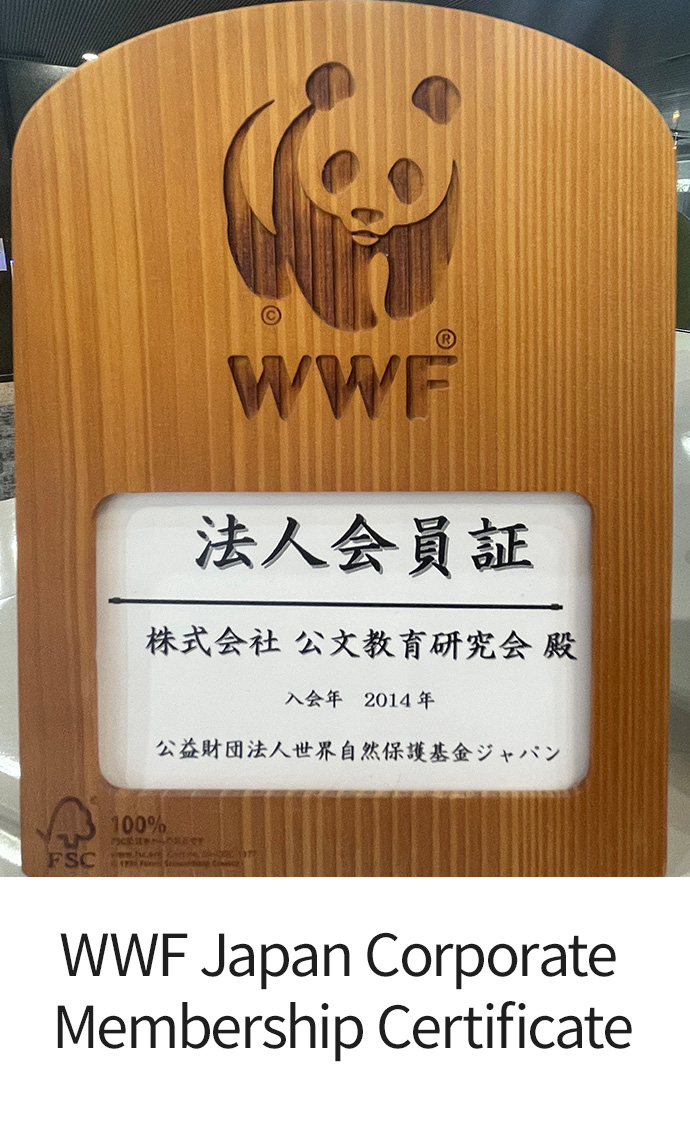
The Kumon Group has been supporting WWF Japan, a member of the WWF Network and a global environmental conservation organization operating in more than 100 countries, through the Kumon Forest Fund since 2014.
WWF was founded in Switzerland in 1961. Its main activities are to protect biodiversity on the Earth and to reduce the impact of human life on the natural environment and wildlife. One of these activities is forest conservation.
WWF Japan works toward sustainable forest conservation through direct activities in the field, such as research and conservation of rare species and reforestation, as well as by supporting local communities and responsible raw material procurement in Japan. In addition, we also conduct public awareness activities through the development of environmental education programs and seminars on the environment.
Through its global network, WWF Japan supports forest conservation activities in countries around the world and is also involved in environmental education. The Kumon Group, which aims to contribute to local and global communities through education around the world, continues to support these activities, as we share the same goals.
Environmental Preservation with External Partners
ESD Activities in Indonesia

Improving the quality of education is one of the major challenges facing Indonesia. In particular, in remote areas such as forested regions, schools and teachers often receive insufficient support, creating challenges for the implementation of educational reforms.
At the same time, these areas are also particularly vulnerable to deforestation. As a result, ESD (Education for Sustainable Development), an approach that integrates education and environmental conservation, has attracted growing attention. Since 2014, WWF Japan has partnered with WWF Indonesia to support educational initiatives for children. In West Kalimantan, on the island of Borneo where these activities are carried out, deforestation has been accelerating due to the expansion of oil palm plantations used to produce palm oil.
Many smallholder farmers expand their plantations to support their livelihoods. However, this expansion has resulted in the loss of valuable forest ecosystems. To address this issue, WWF supports farmers in earning a stable income without expanding their plantations by providing training in improved farming techniques and assistance with cultivating crops such as rice and coffee.
WWF incorporates ESD (Education for Sustainable Development) into school programs, primarily at the junior high school level, creating opportunities for learning that involve not only students but also parents and local community members. In addition, educational materials tailored to local natural environments and cultural traditions are being developed. Through collaboration between teachers and community organizations, four learning subjects were developed: Traditional Cuisine, Traditional Culture, the Environment, and Sustainable Palm Oil Production. Through learning about the unique characteristics of their community, students gain a deeper understanding of the importance of protecting the environment. The program also includes experiential learning opportunities in which students visit plantations and consider how natural resources can be used sustainably. Through activities such as making baskets from oil palm leaves and developing ideas for new products using palm oil, students are gaining firsthand insight into the value of the resources available in their communities. These ESD activities help students see environmental issues as their own responsibility and foster the development of future leaders who can contribute to the sustainable development of their communities.
- *ESD: Education for Sustainable Development. Activities aimed at creating new values and actions that will lead to solutions to various global problems, such as the environment, poverty, human rights, peace, and development, in addition to the creation of a sustainable society.
Forest Conservation Activities in Japan
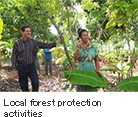
While forests cover approximately 70% of Japan's land area, one of the country's key challenges is not forest loss, but the growing number of inadequately managed forests. Many of the cedar and cypress plantations established after World War II have been neglected, reducing the ability of forests to fully perform their essential functions, such as mitigating the risk of landslides and other natural disasters.
In response to these challenges, WWF Japan has been carrying out full-scale forest conservation activities across Japan since 2024. A key focus of these efforts is promoting FSC certification, an internationally recognized certification system that verifies forests are managed responsibly and sustainably. FSC-certified forests are managed with consideration for both the environment and local communities. However, in Japan, only a small proportion of forests have obtained FSC certification, and public awareness of the certification remains relatively low.
In Minamisanriku Town, Miyagi Prefecture, WWF Japan organized an educational program for high school students. Students visited FSC-certified forests and learned firsthand about the roles forests play and the challenges they currently face. Afterward, the students expressed the attractions and challenges of the forests as they perceived them through rap and shared their message in the form of a music video. Through their music video, the students shared the message that environmental issues are not distant concerns, but challenges that affect us all, expressed through the unique perspectives of young people.
In Higashishirakawa Village, Gifu Prefecture, a project is underway to provide school desks made from FSC-certified timber. By presenting desks made from locally sourced wood to newly enrolled elementary school students, the project helps children feel a closer connection to their local forests. In addition, special lessons are conducted to teach students about forests, forestry, and FSC certification.
Through children and young people, these initiatives help raise awareness of the importance and value of forests throughout the wider community. Protecting forests not only preserves the natural environment but also helps safeguard local livelihoods and the future of communities. Japan's forest conservation projects aim to foster people's appreciation for and pride in their forests, while promoting the expansion of sustainable forest management.
- Environmental Management
of the Kumon Group - Environmental Philosophy and Environmental Policy,
and environmental promotion system
Kumon's
Environmental
Activities
- Environmental
Management of
the Kumon Group - 2025 Activities and
Environmental Data - Environmental
Communication - Kumon Environmental Activities Around the World
- Environmental Preservation with External Partners